XXX: finite spinons and the meaning of an excitation scan
An infinite-chain dispersion is a useful target, but a finite MPS calculation has a particular length, boundary condition and energy reference. This tutorial connects those choices to concrete Bethe results for the spin-1/2 Heisenberg chain. First we approach the single-spinon curve using odd rings; then we compare a restricted triplet family with periodic and free ends. The spectral-weight tutorial continues from these energies to operator intensities and dynamical sum rules.
1. Start with the same Hamiltonian
We use spin operators, not Pauli matrices, with lattice spacing one and antiferromagnetic exchange \(J=1\):
There are no boundary fields. A factor of four separates this normalization from the same expression written with Pauli matrices. As a small-system check:
bethe-xxx-pbc 4
bethe-xxx-obc 4
The ground energies are \(-2\) and \(-3/4-\sqrt{3}/2\), respectively. Removing a bond changes the ground state too: the open-chain energy is not obtained by subtracting a fixed bond energy from the periodic result.
2. Extract a single spinon from an odd ring
An odd ring can carry a spin-1/2 excitation. The supported one-spinon family has \(M=(N-1)/2\) real roots filling all but one of \(M+1\) allowed Bethe slots. The missing slot, or hole, labels the branch.
bethe-xxx-pbc 31 --spinons
bethe-xxx-pbc 31 --spinons --precision fp64 \
  --csv-table states=xxx-states.csv --csv-table spinons=xxx-spinons.csv
The two exported tables join through state_id. states contains the total
energy and lattice momentum; spinons contains the hole coordinate and the
energy suited to a thermodynamic comparison:
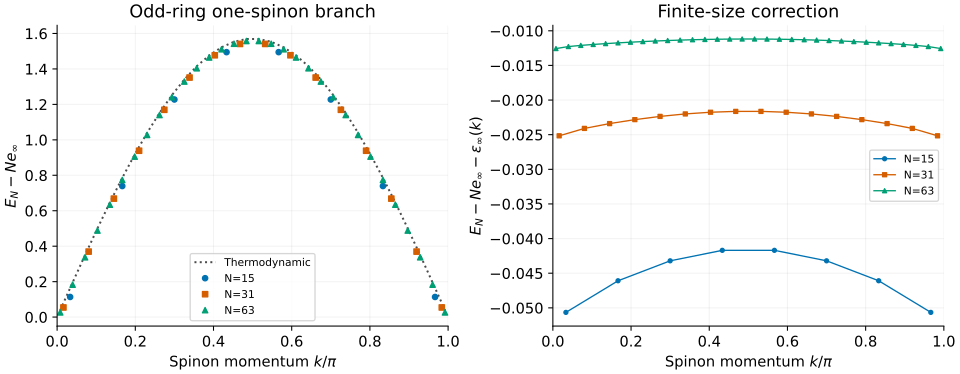
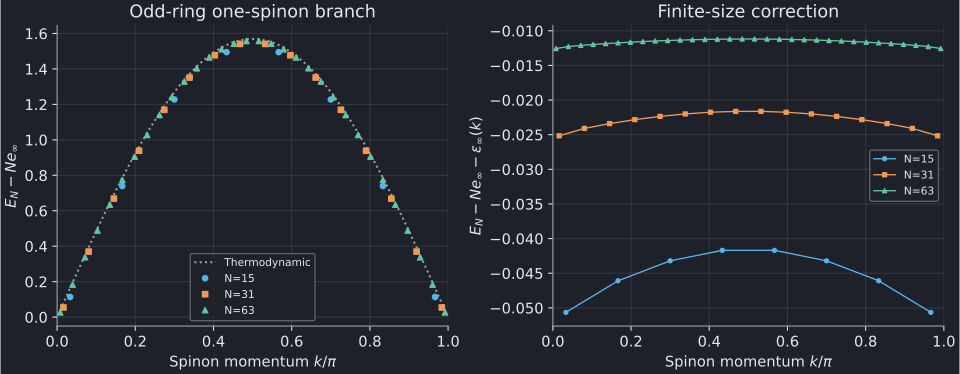
The plotted points come from N=15, 31 and 63 exports. The dotted reference uses the frontend's thermodynamic column, \(\epsilon_\infty(k)=(\pi/2)\sin k\). The right panel magnifies the difference: the finite-size correction decreases along this size sequence but is not a solver error. Increasing arithmetic precision will not remove it.
Download the paired tables:
| Ring | Total states and diagnostics | Spinon coordinates |
|---|---|---|
| N=15 | states | spinons |
| N=31 | states | spinons |
| N=63 | states | spinons |
Two easy ways to compare the wrong curves
Subtracting the finite odd-ring ground energy. That ground state already contains a spinon. Subtracting it forces the lowest finite branch energy to zero and changes the comparison. Here we subtract the extensive bulk energy \(Ne_\infty\) instead; the finite-ring endpoints need not be zero.
Treating spinon momentum as lattice momentum. They are related by
The allowed \(k\) values start at \(\pi/(2N)\), end at
\(\pi-\pi/(2N)\), and have spacing \(2\pi/N\). When comparing an iMPS domain-wall
excitation, align its momentum origin and unit-cell convention; do not simply
replace k by the lattice p column. See the
XXZ tutorial for unit-cell folding and continuum thresholds.
3. Compare triplets with periodic and free ends
On an even chain, select the real-root highest-weight family at total spin \(S=1\):
bethe-xxx-pbc 12 --excitations all --spin 1 --format csv > xxx-pbc.csv
bethe-xxx-obc 12 --excitations all --spin 1 --format csv > xxx-obc.csv
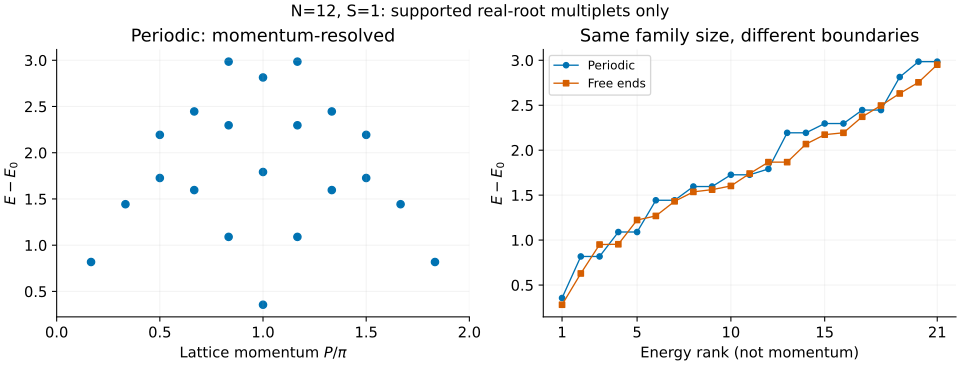
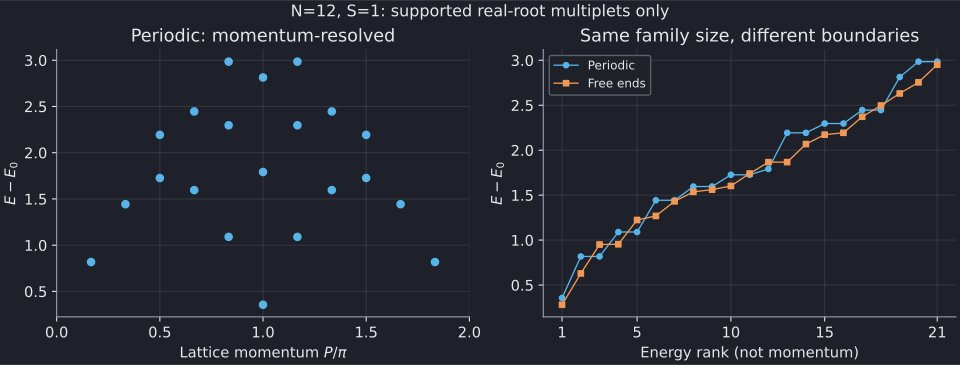
Downloads: periodic scan, free-end scan.
Unlike the odd-ring spinon plot, these gap columns subtract the global
ground energy of the same finite chain and boundary condition.
The left panel plots lattice momentum for the periodic chain. Free ends have no conserved translation momentum, so the right panel compares energy rank, not momentum. Equal ranks do not identify the same physical state under the change of boundary conditions. Lines there only guide the eye.
4. “All” still names a restricted family
Both scans return 21 converged multiplets, not the full triplet spectrum. The implemented real-root window has
At \(N=12,S=1\), this is \(\binom{7}{5}=21\). By contrast, counting spin words gives \(\binom{12}{5}-\binom{12}{4}=297\) triplet multiplets in the full Hilbert space. Each multiplet has three spin projections; the scan represents it once at \(S^z=S\).
For the periodic chain this window is the conventional two-spinon triplet
family. Other triplets and excited singlets require states outside it, such
as complex-root families. In particular, changing --spin to zero does not
request all singlet excitations: the current even-chain real-root window then
contains only the ground-state configuration.
Check Candidates, Converged candidates, Ground status and the overall
Outcome. A failed candidate makes the scan incomplete even if every row
that survived is individually converged. A failed ground reference means the
gaps are unavailable. Asking for --excitations 5 still solves the whole
chosen family before selecting its lowest five results.
This differs from Haldane–Shastry, where --levels all
can describe a complete finite spectrum through exact motif multiplicities.
5. Reproduce and validate
After preparing the optional plotting environment:
python3 scripts/plot_xxx_tutorial.py
# Regenerate all exports from a directory containing both XXX executables:
python3 scripts/plot_xxx_tutorial.py --build-dir /path/to/bethe/bin
python3 scripts/plot_xxx_tutorial.py --check
python3 -m unittest discover -s scripts -p 'test_tutorial_xxx.py'
The tests check the table joins, momentum convention, bulk subtraction, finite-size trend and scan completeness within the stated family. Additional N=4 exports (periodic, free ends) check exact ground energies and the one-magnon spectrum. fp64 is sufficient here; long-double and fp128 can test arithmetic accuracy separately from finite-size effects. For a case where rounding actually erases the energy scale of interest, continue with XXX: when a converged energy is not accurate enough, including a comparison of native and arbitrary precision against an exact one-magnon dispersion.
Further reading
Karbach–Hu–Müller is a pedagogical introduction to finite and infinite-chain Bethe calculations. The odd-chain hole convention is documented with Groha–Essler; this tutorial uses only the unperturbed integrable chain, not its decay-rate calculation. For the thermodynamic branch, see Caux's XXX spinon notes. Implementation details are in XXX states, open chains and excitation scans.