The infinite-chain XXX two-spinon spectrum
The finite-ring tutorial turns individual transition weights into a broadened spectrum. Here we can remove both the finite ring and the plotting broadening: the infinite-chain two-spinon contribution is known directly as a continuous function of momentum and frequency.
For an iMPS calculation, this is a useful reference for where spectral weight lives, not just which energies are kinematically allowed.
A continuum with intensity
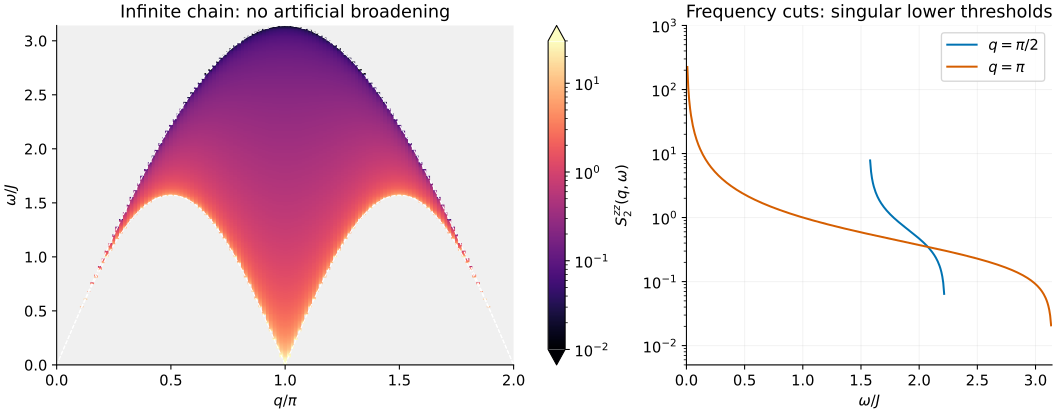
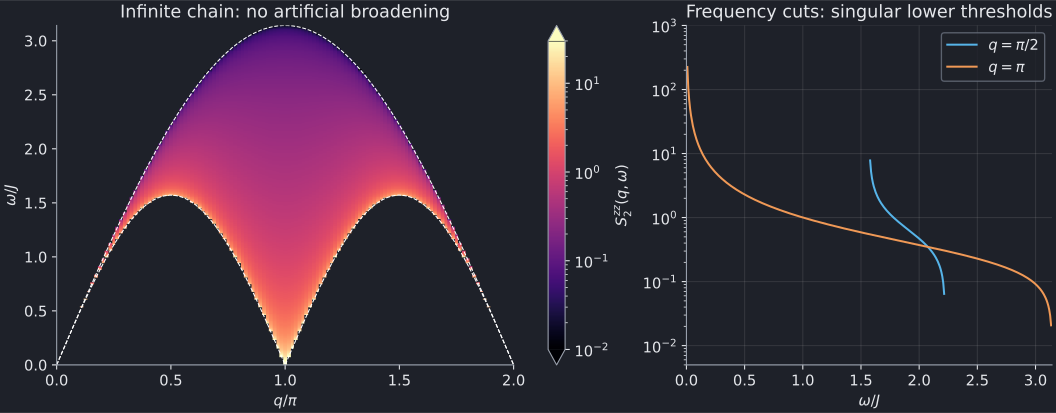
The Hamiltonian is \(H=\sum_j\mathbf S_j\cdot\mathbf S_{j+1}\), with lattice spacing and \(J\) set to one. The heat map shows \(S^{zz}_2(q,\omega)\) on a logarithmic color scale. It uses no artificial broadening. White guides mark the lower and upper two-spinon boundaries. Color clipping is only for visibility; the underlying values are unchanged.
Notice the bright lower edge and the fading upper edge. The density of available states alone would diverge at the upper edge, but the transition matrix elements vanish strongly enough that the physical two-spinon intensity goes to zero there. The right panel shows two frequency cuts from the same data. At \(q=\pi\), the lower edge is at zero energy and the density diverges as that edge is approached. An exactly singular sample is masked, not replaced by a finite value.
Generate the data
After building or installing, run:
bethe-xxx-structure-factor-thermo --momentum-points 129 --points 401 \
  --threads 4 --csv spectrum.csv --csv-table continuum=edges.csv
From a build directory, prefix the executable with ./. Momentum is in
radians per site; the figure divides it by \(\pi\) only for presentation.
The grid spans \([0,2\pi]\) and \([0,\pi]\). Its repeated momentum endpoint
is a periodic plotting seam, not another physical momentum.
For a denser single cut or one point:
bethe-xxx-structure-factor-thermo --momentum 1.5 --points 2001 --csv cut.csv
bethe-xxx-structure-factor-thermo --momentum 1.5 --omega 1.8 \
  --precision fp64 --tolerance 1e-12
The second command gives approximately \(S^{zz}_2=0.87313045511634\).
At these fixed controls, the binary64 and MPFR192 two-spinon values in the
precision comparison differ by less than
\(2\times10^{-15}\) relative. This checks arithmetic at this point; it does not
bound quadrature error or sensitivity near a continuum edge.
--channel raising doubles the density by SU(2) symmetry. --exchange J
rescales the frequency axis by \(J\) and density by \(1/J\).
What to compare with an iMPS spectrum
- Match the Hamiltonian, spin normalization and Fourier convention first. This tool reports \(S\), with the finite-system convention \(S=2\pi\sum_n w_n\delta(\omega-\Delta E_n)\).
- This is two-spinons only. The full local-spin spectrum has additional four-, six-, and higher-spinon contributions, including weight above the two-spinon upper boundary. An iMPS result need not vanish there.
- Do not multiply these intensities to force the full sum rule. The exact two-spinon result accounts for about 72.89% of the full integrated weight and 71.30% of the first moment. The much larger finite-ring fractions in the earlier tutorial are not thermodynamic identities.
- For a time-evolution spectrum with a finite time window, apply the same resolution kernel to a properly integrated reference. Simply comparing peak heights to this unbroadened singular function is misleading.
- A singular point is not a quadrature weight. In particular, integrating the raw heat-map samples with a rectangular rule is not a reliable normalization check. At precisely \(q=\pi\), even the zeroth frequency moment diverges; finite momentum resolution matters.
The model guide explains the formula, numerical error estimates, status fields and the two-spinon scope.
Reproduce the figure
The checked exports are spectral density and continuum edges. From the source directory, with NumPy and Matplotlib installed:
python3 scripts/plot_xxx_thermodynamic_structure_factor_tutorial.py
To regenerate the data as well, put the built executable on PATH and run:
python3 scripts/plot_xxx_thermodynamic_structure_factor_tutorial.py \
  --solver bethe-xxx-structure-factor-thermo
The script checks numerical statuses, provenance, continuum support, grid
ordering and momentum-reflection symmetry before drawing the plot.
Literature is available with --references and in CITATIONS.md.
Continue with the four-spinon refinement tutorial to add the next sector and separate quadrature accuracy from soft-cutoff dependence.