Ferromagnetic biquadratic chain: defects and bound droplets
What sits above the large ground manifold of the positive pure biquadratic chain? There is an exact one-defect band, but it is only part of the answer: several singlet defects can bind, and their levels can interleave scattering states and levels from other algebraic sectors. This tutorial follows those excitations without assigning a fictitious momentum to an open chain.
1. Fix the vacuum reference, not a single vacuum state
Here --ferromagnetic selects
The spins are 1 and the ends are free. The global ground energy is exactly \(E_0=N-1\), and the reported positive gap is measured above the entire ground space, not just the fully polarized representative.
In particular, a physical one-spin lowering of the fully polarized state stays in that ground space. The positive-energy “one defect” below instead means one TL singlet insertion, with \(M=(N-\ell)/2=1\). This is not a count of physical spin flips or a physical total-spin label.
2. Start with the exact one-defect band
bethe-biquadratic-obc 32 --ferromagnetic --one-defect
bethe-biquadratic-obc 32 --ferromagnetic --one-defect \
  --format csv > one-defect.csv
There are N−1 standing-wave modes in the ell=N−2 module:
The wave_number column is \(k_j\), an open-chain standing-wave coordinate,
not a translation eigenvalue. The frontend lists decreasing j, hence increasing
energy. It computes the gap directly, rather than subtracting two rounded
extensive energies.
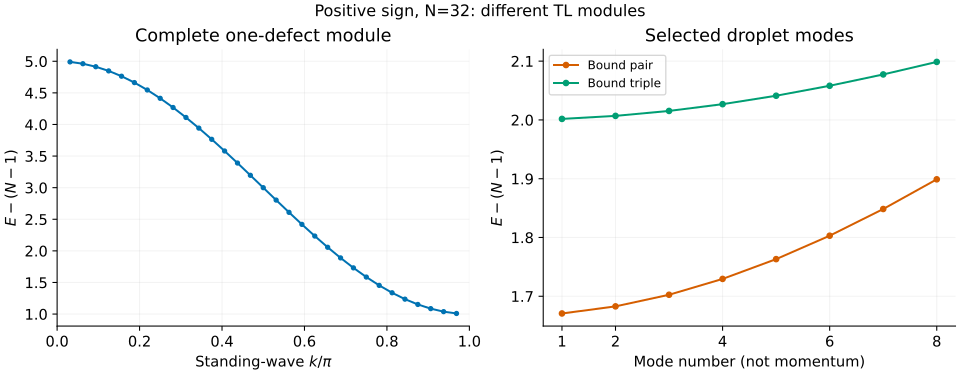
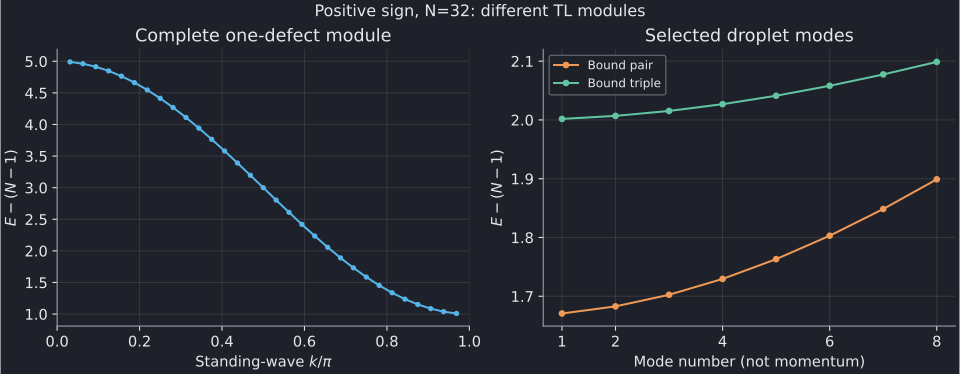
The left panel reads the N=32 analytic-band export. Its lowest level also gives the global positive gap:
This is a spectral-gap result, not merely a variational one-defect estimate; the reference guide explains its TL/XXZ justification. It does not say that the ground manifold has only one state or that all other excitation families are absent.
3. Bind two or three defects
bethe-biquadratic-obc 32 --ferromagnetic --bound-pairs 8
bethe-biquadratic-obc 32 --ferromagnetic --bound-triples 8
The right panel shows these eight selected modes of each family: pairs, triples. Its horizontal axis is a branch mode number, not the standing-wave coordinate of the left panel and not a common momentum. Do not overlay the two panels as momentum-resolved bands.
The pair solver uses a two-string in ell=N−4; the triple solver uses a three-string in ell=N−6. These are finite-size Bethe solutions with string deviations, not ideal-string energies substituted for a finite chain.
Their lowest selected modes approach different thermodynamic edges:
| Excitation family | Limiting gap | Separated objects in the same defect count |
|---|---|---|
| One defect | 1 | — |
| Bound pair | \(5/3\) | Two single defects: 2 |
| Bound triple | 2 | Pair plus single: \(8/3\); three singles: 3 |
A triple's limiting gap equals the two-single-defect threshold numerically, but those states are in different TL modules. Equality of energy is not an identity of quantum numbers or scattering channels.
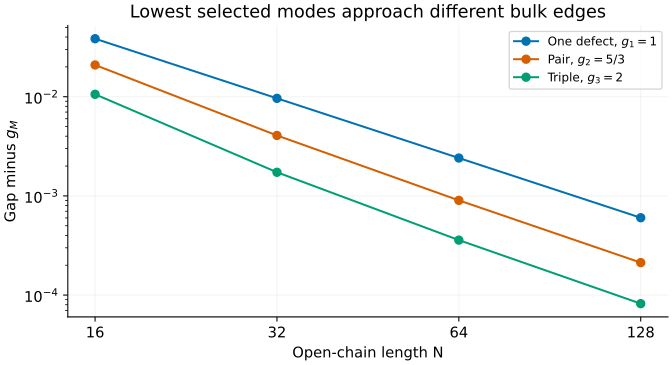
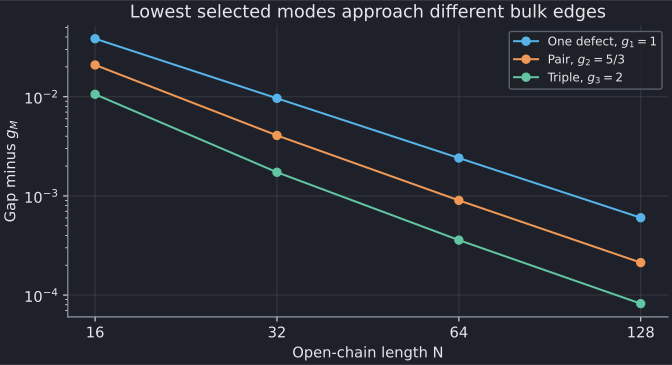
This plot subtracts each family's own limiting edge to expose the finite-size correction. The one-defect gap comes from exact metadata; pair and triple gaps come from the first converged row of each export. No fit is used.
| N | Bound-pair modes | Bound-triple modes |
|---|---|---|
| 16 | CSV | CSV |
| 32 | CSV | CSV |
| 64 | CSV | CSV |
| 128 | CSV | CSV |
N=32 includes eight modes for the earlier plot; the other sizes select only mode 1. Other modules and scattering families can interleave these levels. The thermodynamic edges and small-chain validation do not certify the finite-N global ordering of arbitrary targeted branches.
4. Why a real-root scan can miss a low excitation
Sign reversal keeps the auxiliary roots but reverses the physical energies. The four-site example makes the consequence visible:
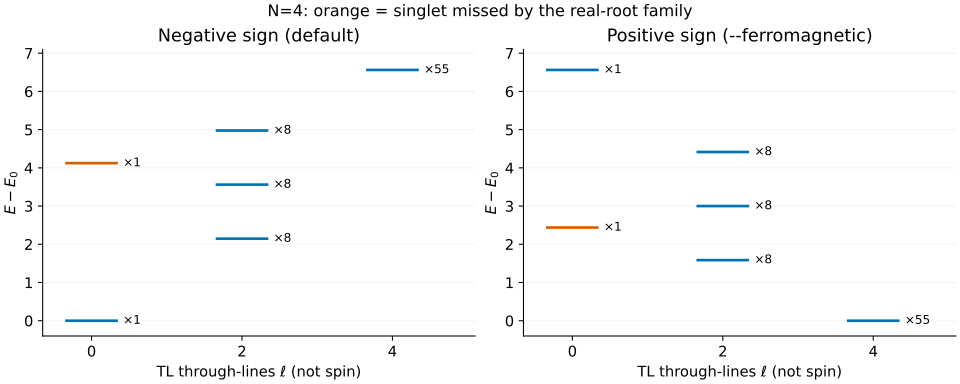
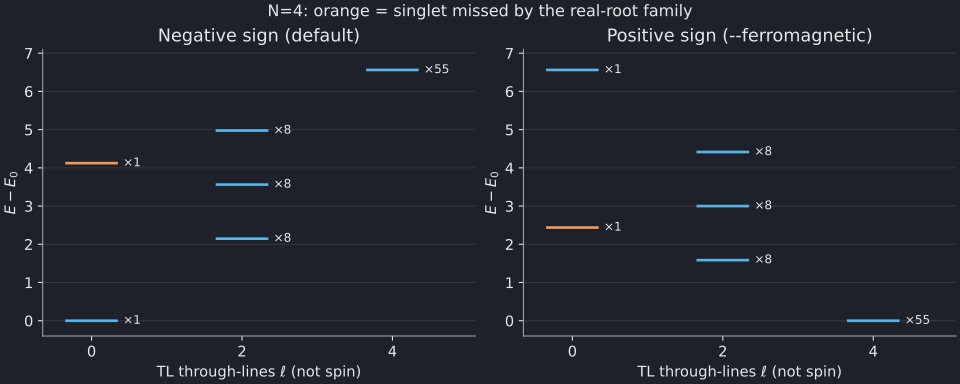
In the positive-sign panel, the ground level at energy 3 has 55 physical states. The first positive level is \(6-\sqrt2\), with multiplicity 8. The two-defect singlet at \((15-\sqrt{17})/2\) already interleaves the one-defect band. It is the orange line, missing from this real-root scan:
bethe-biquadratic-obc 4 --ferromagnetic --through-lines 0 --excitations all
bethe-biquadratic-obc 4 --ferromagnetic --through-lines 0 --q-spectrum --spin-content
The first command returns only the higher singlet. The Q-system request finds both for this small chain. Download the real-root comparison and the full module tables:
| Module | Levels | Spin content |
|---|---|---|
| ell=0 | CSV | CSV |
| ell=2 | CSV | CSV |
| ell=4 | CSV | CSV |
For corresponding states \(E_+=-E_-\), but gaps do not simply change sign:
each Hamiltonian has a different ground reference. The auxiliary
reference_energy is unchanged. Our tests check all of these relationships
and account for all \(3^4=81\) physical states for either sign.
5. Choose the right comparison for an MPS excitation
The ground manifold contains many physical spins. Selecting one MPS ground
state does not guarantee access to every excitation carrying the same TL
multiplicity. The optional spin_content tells you which physical SU(2)
multiplets occur, not their spectral weights or their matrix elements
from that chosen ground state.
Multiplicity counts use checked uint64 arithmetic. Some N=64 and N=128 CSV
rows have an empty multiplicity because the exact count overflows, while
their energies and gaps remain valid. An empty count is not a count of one;
an empty energy or failed convergence status is a different problem.
The commands also make different coverage promises:
--one-defect: the whole one-defect TL module, not the full excited spectrum.--bound-pairs all/--bound-triples all: the supported string labels of that family, not all scattering states at that defect count.--q-spectrum: a numerical search of one module, with explicit discovery and completeness diagnostics; an incomplete search is not a lowest-level list.
For the next step, the implementation also offers real-root scattering windows, pair-plus-defect states, two pairs, triple-plus-defect states and bound quartets. These extend the family inventory, not a claim of a complete thermodynamic spectral function. Open-chain branch coordinates still are not lattice momenta.
6. Reproduce and check
The negative-sign tutorial gives the shared plotting/regeneration commands. The tests check exact four-site levels, physical-spin counting, energy sign reversal, the standing- wave band, finite-size droplet trends, overflow handling and rejection of failed calculations. The examples use fp64; long-double and fp128 remain available when the build supports them.
Further reading
The positive gap follows from the TL mapping and Koma–Nachtergaele. The droplet limits follow Nachtergaele–Spitzer–Starr after converting the energy convention. For implemented finite-string equations and diagnostics, see the pair and triple guides and their attribution to Bajnok et al..