TB spinons: the same edge can hide a different sector
The spin-1 Takhtajan–Babujian (TB) point is another useful benchmark for MPS excitation calculations. Its elementary dispersion is a sine curve, but identifying the physical excitation takes more than rescaling a spin-1/2 Heisenberg result. This tutorial separates the energy scale, total-spin selection rules and two-/four-spinon kinematics.
1. Fix the normalization first
We use spin-1 operators and
The two-site energies in total-spin sectors 0, 1 and 2 are −6J, −2J and 0. This is a quick normalization check in an independent MPS implementation. For coefficients cos θ and sin θ at θ=−π/4, choose \(J=1/\sqrt{2}\) instead. Beware the J/4 prefactor in Vlijm–Caux: their J=4 corresponds to our J=1.
After building, run
bethe-tb-dispersion --exchange 1 --points 193 --csv tb-unfolded.csv
The single dispersion table contains spinon, two-spinon and four-spinon
rows. Plot energy for the first and lower/upper for the other two.
The grids are uniform in physical momentum, not in rapidity.
2. Read the elementary line
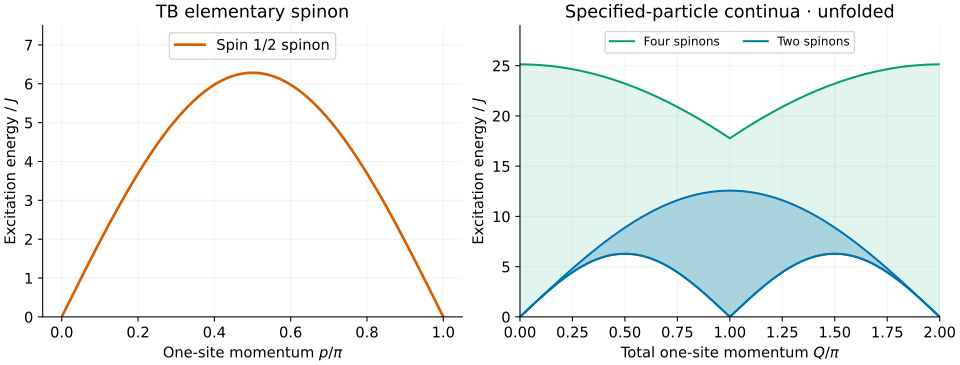
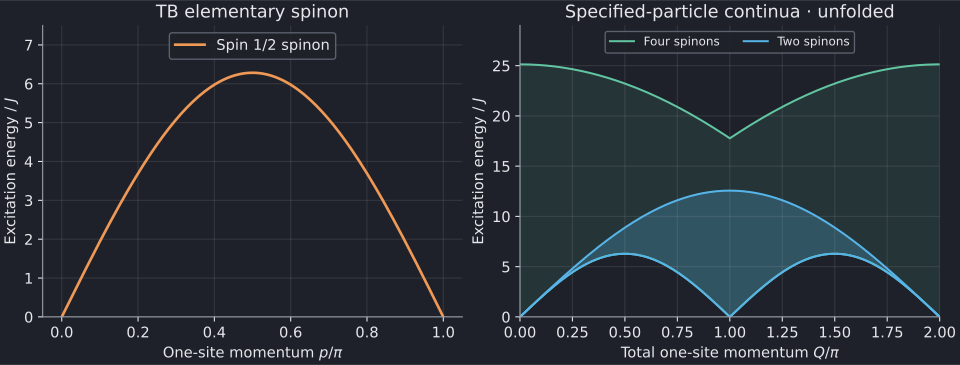
Full-size figure: light · dark.
The endpoints are gapless and the maximum is 2πJ, approximately 6.283185 J. Each elementary spinon carries spin 1/2, although the physical sites have spin 1. A single spinon cannot be an isolated eigenstate of an ordinary periodic integer-spin chain; use an appropriate fractional/domain-wall sector when comparing the elementary line to an ansatz.
3. Match the operator to the particle content
Starting from a singlet ground state:
| Operator | Selected total spin | Smallest spinon content allowed by spin |
|---|---|---|
| Scalar bond or dimer operator | 0 | Two |
| Local spin operator | 1 | Two |
| Rank-two quadrupole | 2 | Four |
Two spin-1/2 objects can form S=0 or 1, but not S=2. Four allow all three. This is why a quadrupolar MPS branch needs the four-spinon comparison, even though the two- and four-spinon lower edges coincide:
Soft spectator spinons can preserve the minimum energy while changing the allowed spin sector. Equal lower curves do not mean equal state counting, matrix elements or excitation content.
The upper edges illustrate a separate point. At Q=0 the two-spinon interval collapses to zero, whereas four spinons can have total constituent momentum 2π and hence Q=0 modulo 2π. Their maximum energy is 8πJ. Ignoring that momentum alias would incorrectly remove a large kinematic interval.
Neither upper edge limits arbitrarily many spinons. Nor does shading show spectral weight: the Q=0 total-spin operator annihilates the singlet, despite the allowed four-spinon energy interval.
4. Fold for a two-site cell
bethe-tb-dispersion --exchange 1 --points 193 --folded --csv tb-folded.csv
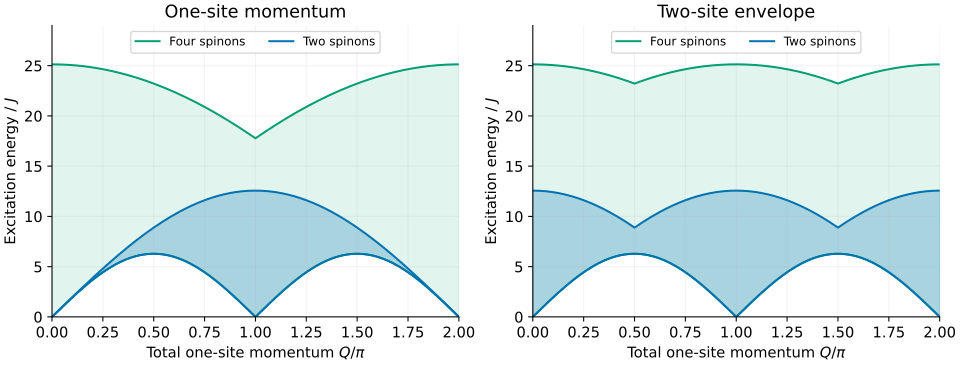
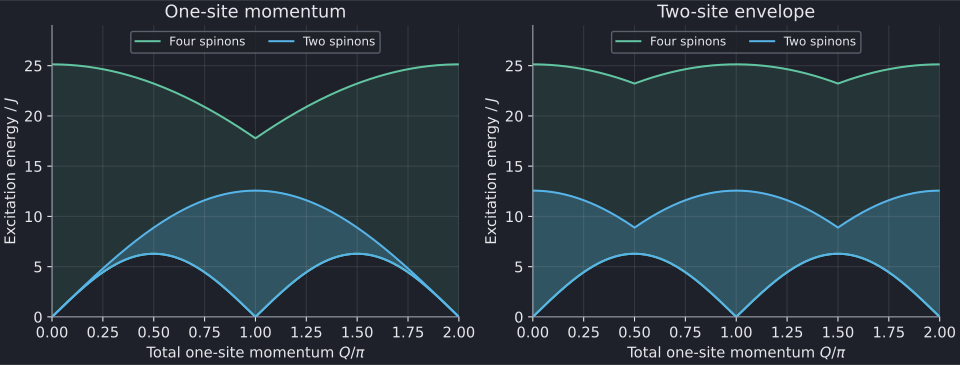
Full-size folding comparison: light · dark.
Translation by two sites measures \(K=2Q\pmod{2\pi}\). The folded envelopes combine Q and Q+π, retaining Q/π on the plotted horizontal axis. The right panel therefore shows two copies of the reduced zone. Keep \(0\le Q/\pi\lt1\) and double that coordinate to plot a single zone against K/π.
The lower edge is unchanged; the upper edges change. The elementary spinon
line is unchanged by --folded. Zone folding here is not evidence for a
gapped or spontaneously dimerized vacuum at the critical TB point.
5. What this does—and does not—test in an MPS calculation
Matching the elementary energy scale and continuum bounds is a useful first check. It does not make TB the XXX chain with a different exchange: the low-energy theories and spinon state counting differ. TB has SU(2) level-2 critical structure, with central charge 3/2. The present plots do not infer finite-size multiplicities from the sine dispersion.
A small ring also need not have a zero staggered gap. It has finite-size levels and logarithmic corrections; a positive finite-ring gap is not a thermodynamic mass. The finite-ring tool solves its supported ground states with finite complex-root deviations retained. It is not an excited-state enumeration based on ideal strings.
Reproduce the figures
Download unfolded and folded exports. The shared spin-1 plotting script also reproduces the ULS tutorial. Using the Python environment described there:
# From the source checkout:
python3 scripts/plot_spin1_tutorial.py
python3 scripts/plot_spin1_tutorial.py --check
python3 -m unittest discover -s scripts -p 'test_tutorial_spin1.py'
The checks need neither Matplotlib nor a C++ build. They test the 2πJ scale, shared lower edges, four-spinon Q=0 upper edge and two-image folding, as well as schema, status, spin labels and momentum units. Numerical exports retain their original precision; these plotting examples use fp64.
For formulas, finite-size checks and precision limits, see the TB dispersion guide. Its references include Vlijm–Caux for normalization and spinon construction, and Frahm–Stahlsmeier for the additional state-counting structure.