Supersymmetric t–J: holes, spin and the Heisenberg limit
All tutorials · Model guide · XXX tutorial
The local t–J Hilbert space contains a hole, an up electron or a down electron: double occupancy is absent. That makes the model natural for projected fermionic MPS. This example benchmarks selected populations on a finite ring, then checks the no-hole reduction and the meaning of the nested roots.
1. Match the Hamiltonian before comparing energies
The integrable point implemented here has t=1 and J=2:
The projection removes doubly occupied sites. There is no chemical potential or magnetic field. The density interaction is included: removing it changes the model, not merely the output notation. Fermions have periodic boundary conditions, including the Fock-space sign of hopping across the boundary. The tool requires at least three sites and does not accept arbitrary J/t.
bethe-tj-pbc 16 --particles 14 --sz 0 \
  --csv-table states=tj-state.csv --csv-table first_roots=tj-first.csv \
  --csv-table second_roots=tj-second.csv
This fixes seven electrons of each spin and two holes. Its energy is about -20.98787126, or -1.311741954 per site. It is a minimum within those fixed populations, not a minimization over particle number.
2. Compare selected fillings
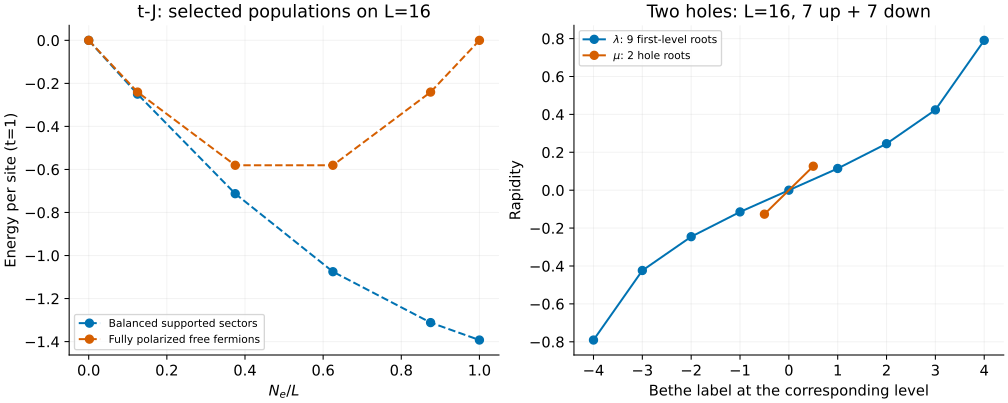
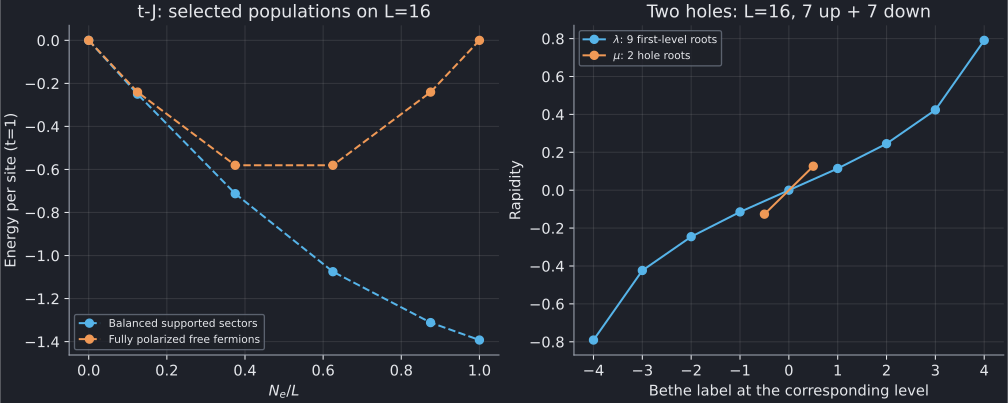
The blue markers use N_e=0, 2, 6, 10, 14 and 16. The orange markers have the same electron counts but all spins aligned. Dashed lines only connect the chosen populations; they do not fill in uncalculated sectors or define a thermodynamic equation of state.
For a doped mixed-spin calculation, the current branch requires both spin populations odd. Thus the 3+3 sector at N_e=6 is supported, but 2+2 at N_e=4 is not. The missing balanced points at 4, 8 and 12 are an implementation restriction, not forbidden physical states or discontinuities in the energy.
There are two exceptions:
- No holes: all physical spin populations are supported through the XXX solver.
- Vacuum or full polarization: exact periodic free-fermion occupations work at every particle count.
For polarized states, the exchange and density terms cancel and the energy is \(E=-2\sum_{k\,\mathrm{occupied}}\cos k\). Even electron counts select a positive-current free shell when there is a choice. The polarized curve is a different spin sector, not an excited dispersion at fixed balanced populations. No spin or charge excitation lines are produced by this frontend yet.
3. Why are there nine roots for fourteen electrons?
The implementation uses the Sutherland grading of the nested Bethe ansatz, as given by Essler–Korepin, Eq. (3.73). After choosing the majority spin as reference, the root counts are
For L=16, N_e=14, these are nine first-level lambda roots and two second-level mu roots, exactly as in the right panel. Neither count equals the total number of electrons. There is no mu–mu self-scattering; copying another model's nested equations would give the wrong system.
With the Hamiltonian above, the energy is
The reproduction script evaluates this from the exported rapidities and checks both original rational equations. Lambda is the conventional rapidity, not the XXX frontend's coordinate z=2 lambda. The paper also uses a shifted supersymmetric Hamiltonian,
When comparing across fillings, forgetting this shift changes the slope of the energy curve. It cannot be repaired with one particle-independent offset.
4. Remove all holes: energy agrees with XXX, momentum needs care
At unit filling hopping is blocked and every bond has \(n_jn_{j+1}=1\):
For the four-site singlet, \(E_{\mathrm{XXX}}=-2\) and the t–J result is -6. The six-site singlet gives \(E_{tJ}=-5-\sqrt{13}\simeq-8.60555128\). Both are saved as normalization checks. The second-level table has no rows because there are no holes; first-level spin roots remain.
The fermionic translation operator differs from a spin permutation. Moving an occupied site around a fully filled ring gives the sign \((-1)^{L-1}\). Thus even L requires an additional \(\pi\) relative to the XXX spin momentum. The four-site t–J singlet reports P=\(\pi\), not the spin chain's P=0. At L=6 the XXX singlet has spin momentum \(\pi\), so the fermionic state reports zero modulo \(2\pi\). A correct energy is not sufficient to verify momentum conventions.
For an MPS benchmark, match the projected local basis, density interaction, boundary parity convention, population and translation operator. This is a finite-ring calculation; it does not remove finite-size or finite-bond-dimension errors from an iMPS comparison. Spin reversal preserves energies but does not justify changing a requested spin sector to evade the shell restriction.
5. Reproduce and validate
Balanced examples (all L=16):
| N_e | State | First roots | Second roots |
|---|---|---|---|
| 2 | CSV | CSV | CSV |
| 6 | CSV | CSV | CSV |
| 10 | CSV | CSV | CSV |
| 14 | CSV | CSV | CSV |
| 16 | CSV | CSV | empty CSV |
The vacuum uses a state and empty free-mode table, not nested roots.
| Polarized N_e | State | Occupied integer modes |
|---|---|---|
| 0 | CSV | empty CSV |
| 2 | CSV | CSV |
| 6 | CSV | CSV |
| 10 | CSV | CSV |
| 14 | CSV | CSV |
| 16 | CSV | CSV |
Additional analytic and spin-reversal checks:
| Case | State | First roots | Second roots |
|---|---|---|---|
| Four-site no-hole singlet | CSV | CSV | empty CSV |
| Six-site no-hole singlet | CSV | CSV | empty CSV |
| L=5, 3 up + 1 down | CSV | CSV | CSV |
| L=5, 1 up + 3 down | CSV | CSV | CSV |
With the plotting dependencies, from the source checkout:
python3 scripts/plot_fermion_tutorial.py --check
python3 scripts/plot_fermion_tutorial.py
# Optional: regenerate this and the Gaudin–Yang tutorial together.
python3 scripts/plot_fermion_tutorial.py --solver-dir /path/to/bethe/bin
python3 -m unittest discover -s scripts -p 'test_tutorial_fermion.py'
The script joins tables by provenance, checks populations and branch-specific schemas, reconstructs energies, and tests rational equations and no-hole fermionic momentum. The regressions additionally check the exact L=5 imbalanced energy \(-3-\sqrt5\), the two-electron energy -4, free limits, spin reversal and corrupted exports. The broader C++ suite independently compares supported small chains with projected-Fock-space diagonalization. Numerical failures may retain an unconverged estimate: reject their status rather than plotting it. fp64 is used here; native long-double and optional MPLAPACK fp128 are available without changing the equations or supported sectors.